IK Pegasi and the Double Merger Path to Type Ia Supernovae
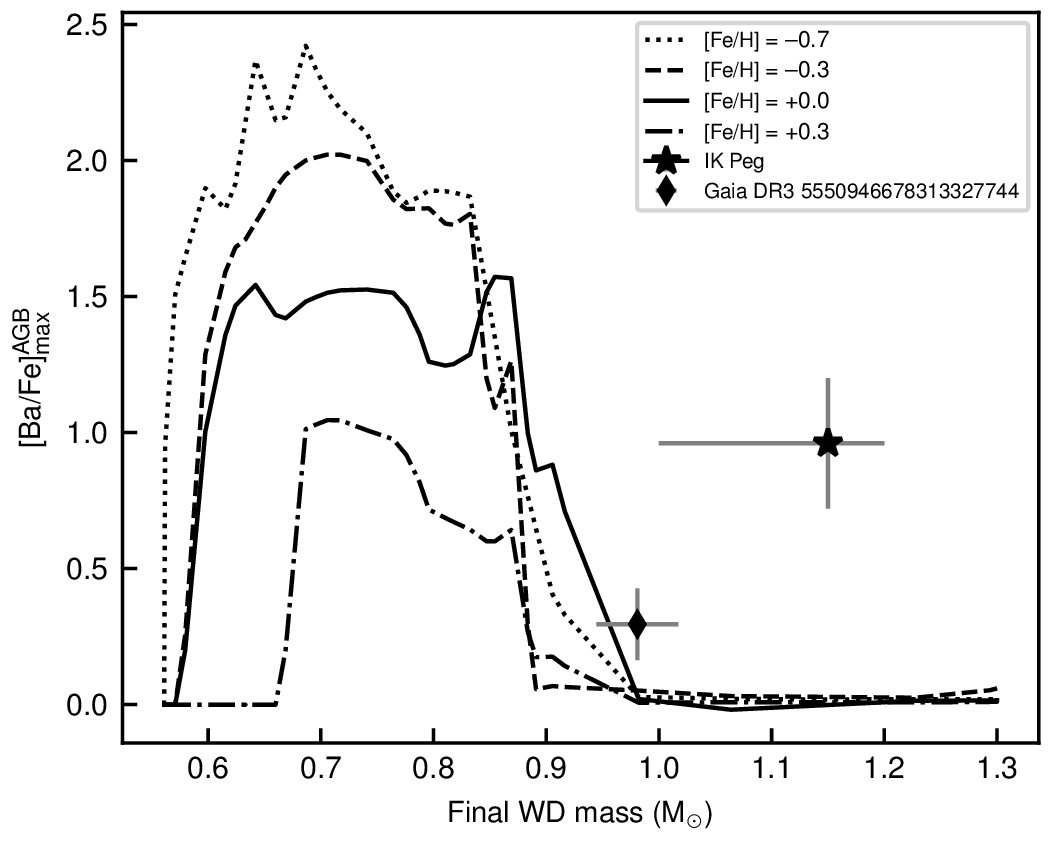
Recent Gaia astrometry has revealed thousands of main-sequence + white-dwarf binaries (MS+WD) at separations of ~0.1-10 au, including a subset hosting unusually massive (>~0.8 Msun) WDs. We argue that s-process enrichment in the non-degenerate companion provides a powerful diagnostic for identifying WDs that formed via mergers in hierarchical triple systems. For a massive WD, standard single-star evolution requires a massive (>~4 Msun) progenitor, yet such progenitors produce negligible s-process yields. We define IK Peg-type systems as those exhibiting this mass-yield tension: barium-enhanced companions orbiting WDs too massive to have descended from efficient s-process producers. The well-known system IK Peg exemplifies this class. Applying this framework to published spectroscopic data reveals several additional candidates, and we estimate that a few dozen such systems should exist in the current Gaia sample. If these systems trace inner-binary mergers in primordial triples, they represent observable intermediate stages towards eventual Type Ia supernovae via the double-merger pathway, as predicted by recent population-synthesis models.
For further reading:
- Na'ama Hallakoun*, Sahar Shahaf*, Sagi Ben-Ami, Oren Ironi, Param Rekhi, and Hans-Walter Rix "IK Pegasi and the Double Merger Path to Type Ia Supernovae" 2026, The Astrophysical Journal Letters, in press *Equal contribution